Wer macht die Nazis?

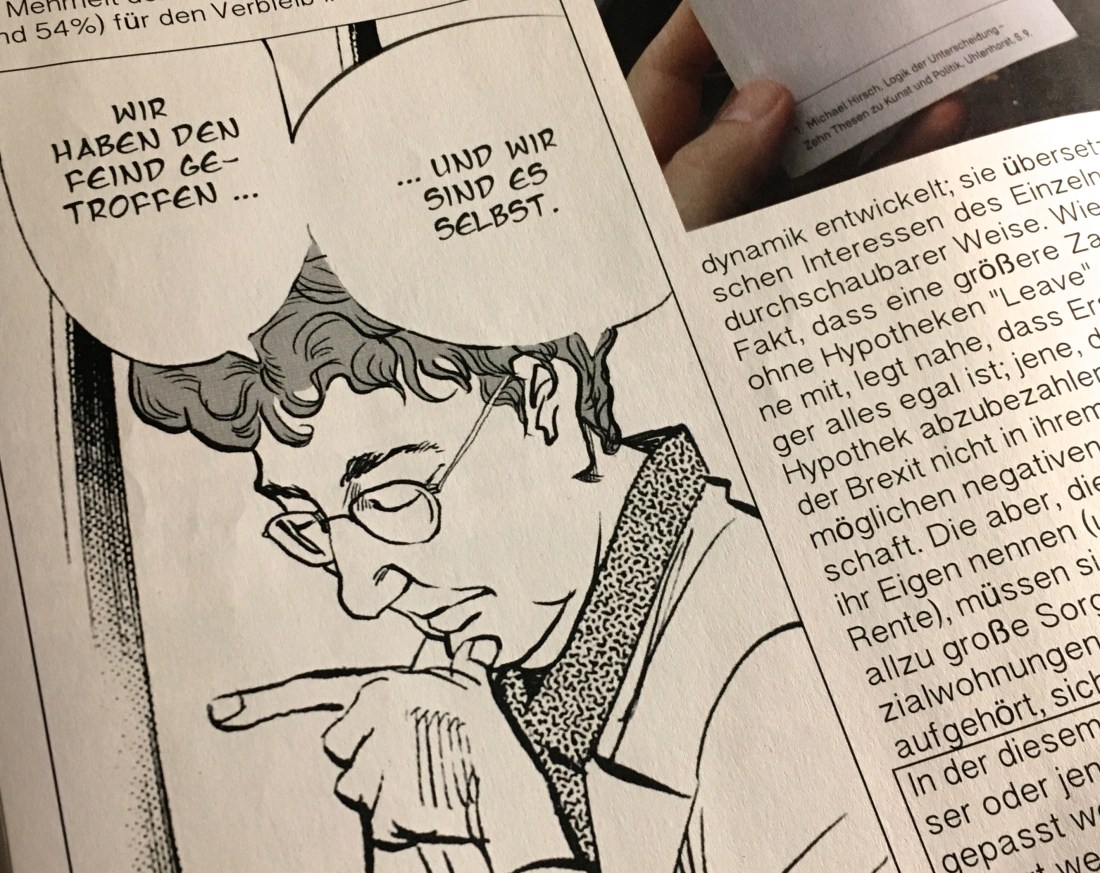
This summer, a German group of artists and writers calling themselves Eurogruppe published the first issue of a zine titled Intercity (a self-described “Zeitschrift für Föderalismus und Polyamorie”), for which they translated my 2016 e-flux journal essay “Who Makes the Nazis?” The magazine is apparently distributed for free within certain networks in Germany. The editorial address is listed as BRD Exil, c/o CONRADI, Rue de la Régence 67, 1000 Brussels. Not much seems to be going on at https://eurogruppe.be yet.

IMG_3718

The essay was originally published in e-flux journal in October 2016, so still in the pre-Trumpocene. I was guest-editor for this issue, titled “Perfect Storm,” and on September 30 I sent in a draft for the editorial, which started as follows: “On November 8, 2016, Donald J. Trump will win the American presidential election.” I was told that this would never happen, and the editorial was published without the offending opening salvo.

In an accelerating catastrophe, texts responding to political urgencies can date quickly. “Who Makes the Nazis?” is no exception, yet like the “Perfect Storm” issue as a whole it still provides elements for a fundamental analysis of the rightward drift of American and European politics. “The Powers of the False” from Texte zur Kunst is a more recent sequel of sorts.

Future Caucus

On May 20, Eric de Bruyn and I are presenting a “Future Caucus” as part of the Van Abbemuseum’s ten-day programme Becoming More.

Not too long ago, Fredric Jameson’s phrase that “it has become easier to imagine the end of the world than the end of capitalism” was widely quoted and taken as proof of a decline—or indeed collapse—of the utopian imagination, which Jameson himself has analysed so compellingly in its literary (science-fiction) manifestations. Today, there is an abundance of neofuturisms, futurologies, speculative philosophies and accelerationist scenarios. What seems at stake here is a fundamental split between a “capitalist realism” that encapsulates the future in an ever-expanding process of accumulation, and a tendency that in the face of a looming planetary catastrophe attempts to imagine another future, which can be conceptualized as the liberation of human potential or, alternatively as the proliferation of posthuman alterities.
GetFileAttachment

The tropes of “the end of history” and  “the end of the future” are now replaced on the one hand by crisis-laden motif of the “end of the earth” or the  “end of labour”, and on the other hand by a return to the future through a series of recent, themed exhibitions, festivals and biennials as well as a resurgence of artificial intelligence and automation in the popular imagination. Despite this return to the future, the temporal horizon of our present moment is perhaps more aptly characterized by the “shrinking future” of just-in-time production, risk management, high-frequency trading, and the futures market. “Speculative” artistic and intellectual practices seem little inclined to problematize their implication in a speculative market whose movement is marked precisely by a perpetual extension of the present and a colonization of the future.

The ‘future caucus’ is convened to address the following questions: Could it be that the total privileging of a radically different future (itself a modernist move) over various pasts and presents is not itself a dangerous impoverishment? What can be learned from historical futurities and potentialities? Do we need to distinguish between a return to the futurity of utopian thought and revivals of a specifically modernist, utopian imagination? Is there a repressed content of utopian thought to be discovered that might speak to our current predicament?

Speakers and moderators are McKenzie Wark, Maurizio Lazzarato, Ana Teixeira Pinto, Diederich Diederichsen, Marina Vishmidt, Doreen Mende and Kodwo Eshun. There are also pleasing connections with some of the other days; on the 21st, for instance,  Graeme Thomson and Silvia Maglioni will present a session of their Cinema Tarot.

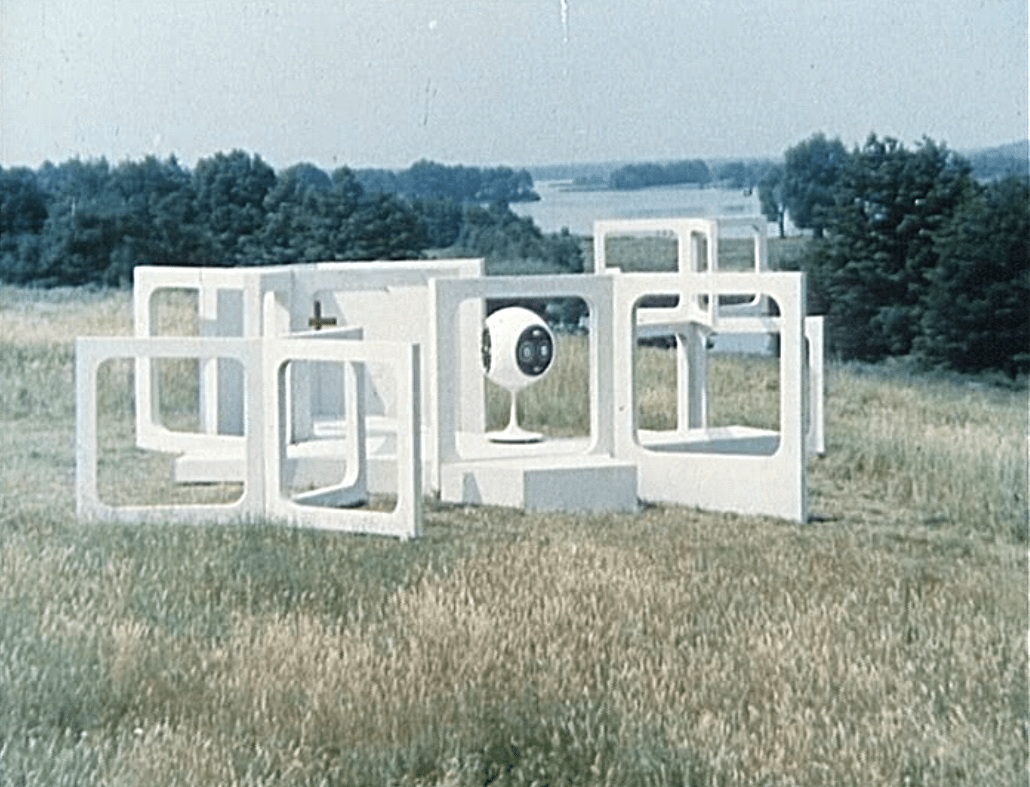
Image:  Joachim Hellwig / Claus Ritter, Liebe 2002, DEFA futurum, 1972.
Van Oldenborgh in Venice

GetFileAttachment

You’d never know it from the official announcements and press releases sent out by the so-called Mondriaan Fund, which carefully omit any mention of my name, but I contributed an essay to the catalogue of Wendelien van Oldenborgh’s exhibition in the Dutch Pavilion at the Venice Biennale, Cinema Olanda. The biennale and hence Wendelien’s show have just opened, though I won’t be able to visit until later this year.

Photo by Vivian Ziherl.

Texte zur Kunst no. 105: The Powers of the False

3b1681d2-2753-44a0-9a86-96702cbfbdf6-cover105_t_w854

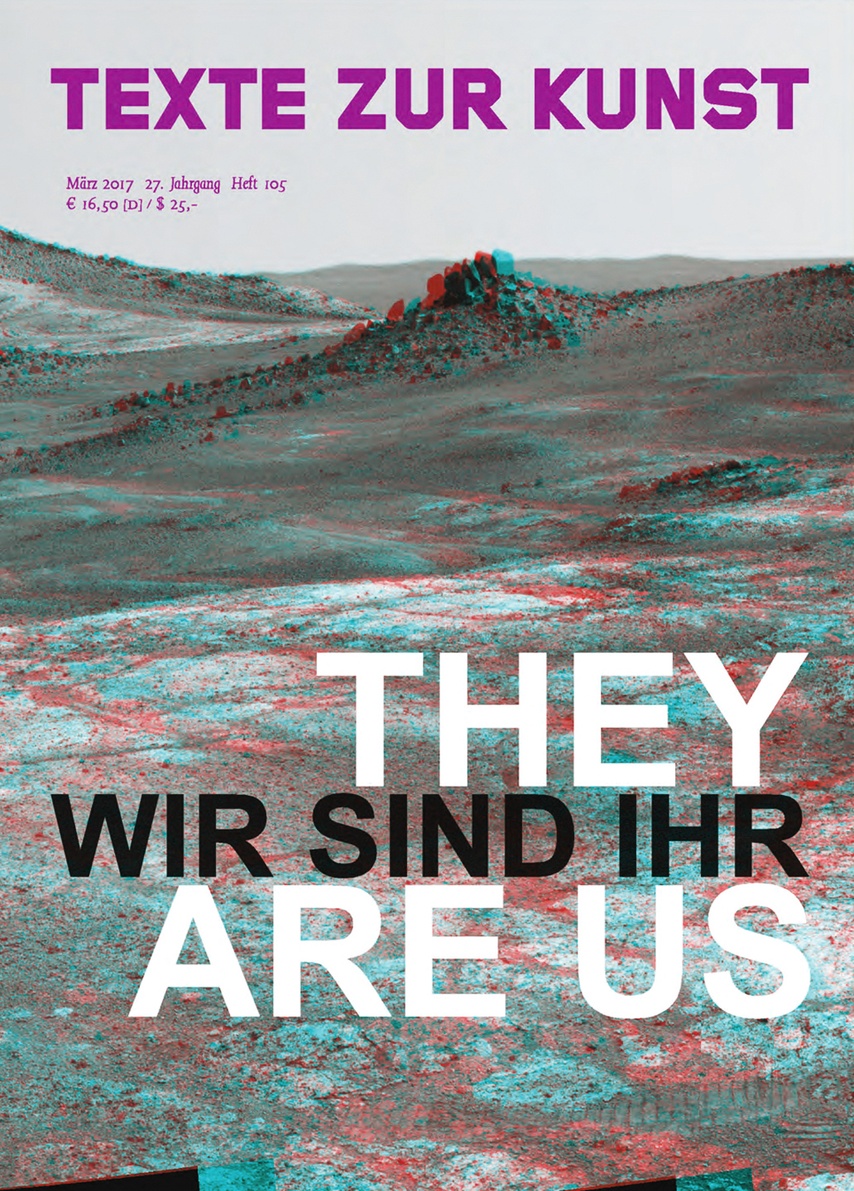
“With Issue #105, TZK considers the nationalist, conservative, and racist ideologies that have recently become more visible across Europe and the US, giving particular focus to questions of border politics and migration — of humans, of data, of patrimony, of signs. Advised by Helmut Draxler, Isabelle Graw, and Susanne Leeb, this issue was conceived prior to the US presidential election as a cooler reflection on present political debates; and yet having been produced amid the chaos of the Trump administration’s first weeks, it also, necessarily stands as a reflection of political-aesthetic thinking during markedly volatile times: Wir sind Ihr? They are us? We are them?”

The table of contents is here. My contribution is an essay titled “The Powers of the False.”

A Delay in Print

photo-2-4

Late last year, Willem de Rooij’s Index book was finally printed – and I have just received my copy. De Rooij’s piece Index. Riots, Mourning and Commemoration (as represented in newspapers, January 2000 – July 2002) is a series of framed wall panels that has now been reformatted for the medium of the book. I wrote my accompanying essay in the spring of 2015, as the Pegida movement was taking off and refugees dominated the media. As I note in a postscript, the slow book production process meant that I could not give critical feedback on these developments in real time, yet I felt I had no option but to reflect on De Rooij’s already historical piece in a way that fully acknowledged this temporal conjunction between the time documented by the piece (just before and after 9/11) and the moment of writing. The postscript is dated 13-14 November 2015; it was written right after the Bataclan massacre. I don’t think that anybody at the time assumed that it would still be a full year till publication. In an accelerating catastrophe, this decelerationist book makes for a curious temporal palimpsest. It is none the worse for that.