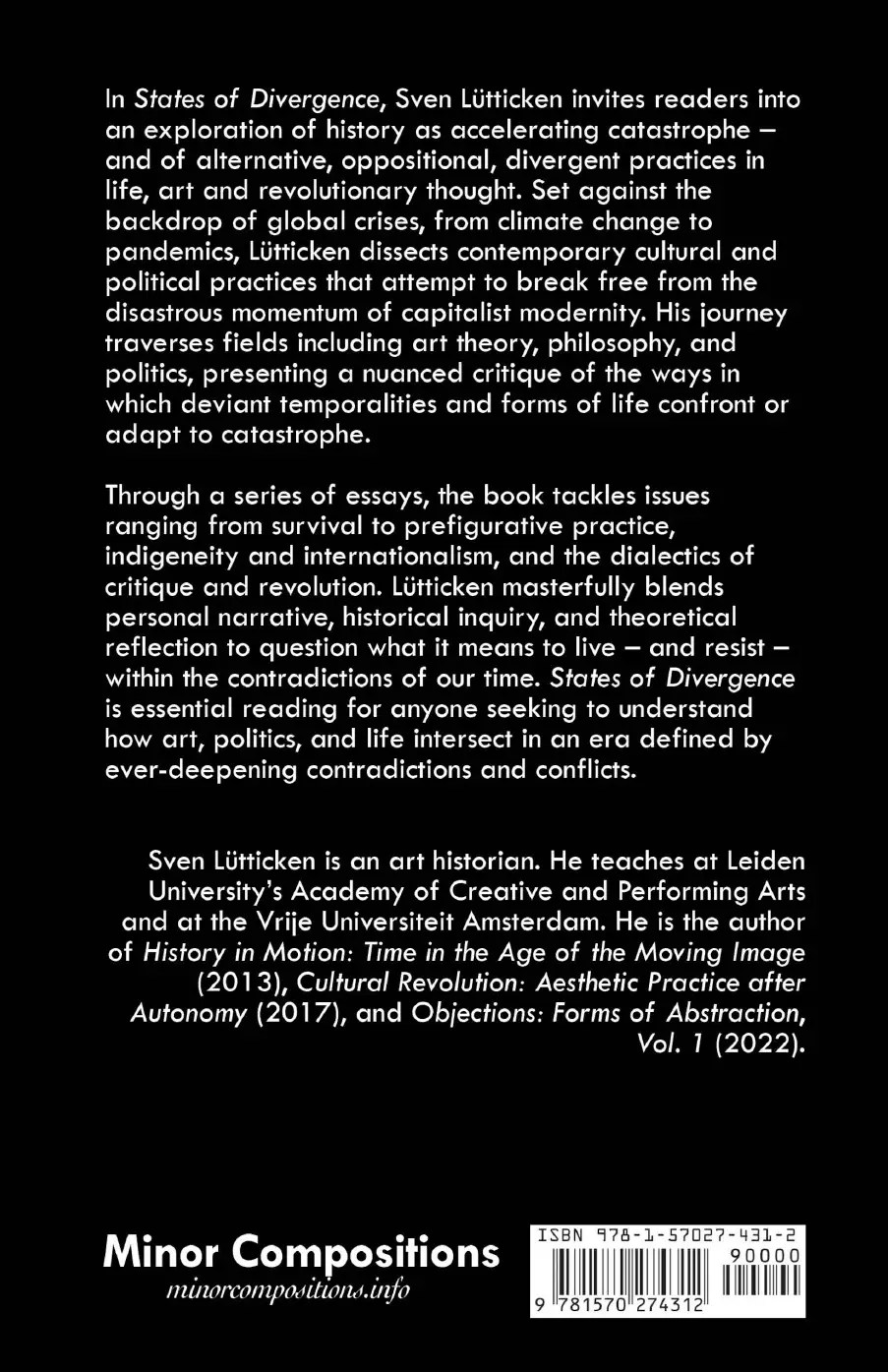
My book States of Divergence is now available from Minor Compositions. A (free!) PDF is available on their website, where people in the UK can also order print copies. The print edition should also soon be available from a variety of offline and online bookstores.
The latest issue of e-flux journal contains my essay “Forms of Strife,” the last section of which discusses the clampdown on academic and civil liberties in Europe and the US in relation to genocidal attacks on forms of life in Palestine and other post/neo-colonies. Right after the issue was published, ICE arrested a Palestinian (former) student who had led protests at Columbia, Mahmoud Khalil. The Trump regime presents Khalil as “the first of many” be deported.
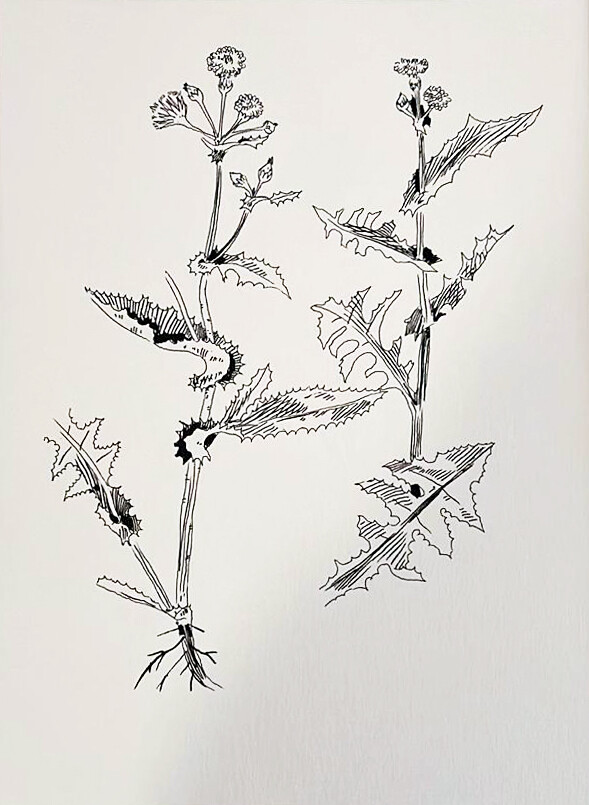
In exchanges with colleagues, I find myself discussing the question how critical pedagogy will be possible in the years to come. With zombie neoliberalism either axing programmes and departments or making them inhospitable to meaningful thought and practice, and with neofascism decreeing crucial field of inquiry taboo, forms of life in academia and culture will need to have the resilience of weeds.
Image: drawing from Marwa Arsanios’s series Resilient Weeds.
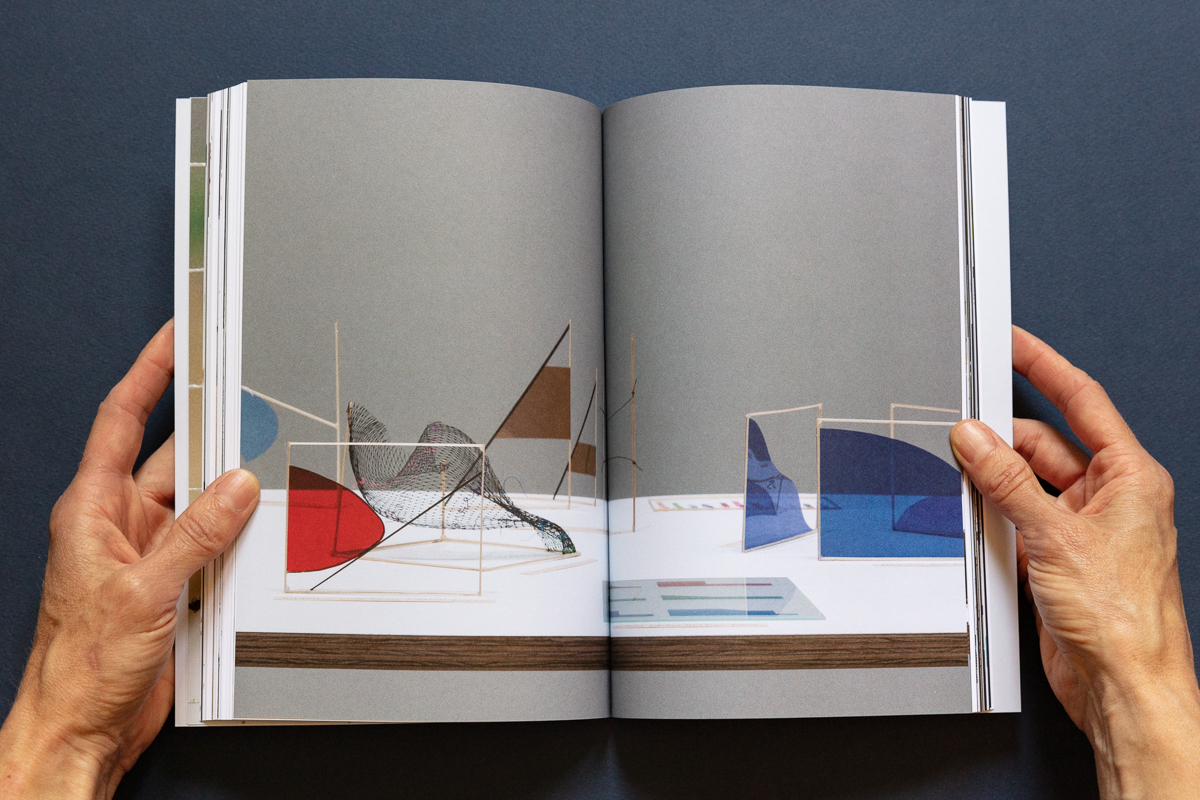
Out now from XYZBOOKS is a long-delayed yet still timely publication around Richard Ibghy and Marilou Lemmens’s series The Prophets:
This book focuses on Richard Ibghy & Marilou Lemmens’ seminal work The Prophets (2013–2015), a delicate hand-made collection of 412 small, whimsical sculptures made from everyday materials that renders economic graphs into makeshift models. In this work, the artists explore what it means to move from a material world of entangled, interacting agents to a world of mathematical modelling and graphical abstraction. The Prophets cuts across a wide range of historical and contemporary topics of interest to economists such as labour, consumption, production, taxes, savings, investments, credit and so on, to constitute a diagrammatology of economic thought. With essays by Sven Lütticken, Harro Maas, Marina Roy, and Jakub Zdebik and Foreword by Peggy Gale.
The various texts appear to form a great constellation with the documentation of the project. I have to look further into it, but my first impression is that this is how to do it; how to extend artistic practice and research in publishing, in dialogue with various scholars and theorists. If anything, my own contribution (“Prophetic Realism,” an offshoot of Objections) feels fairly minimal and minor, due to time and energy constraints—but I’m glad to be part of the mix.
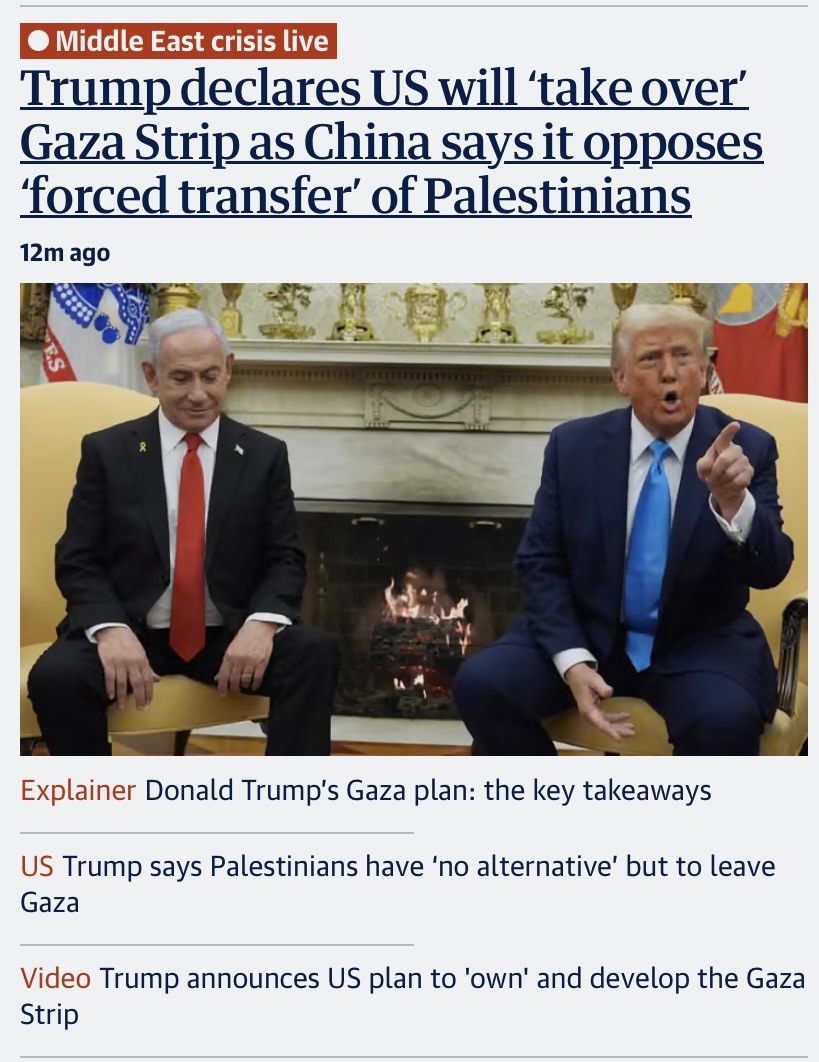
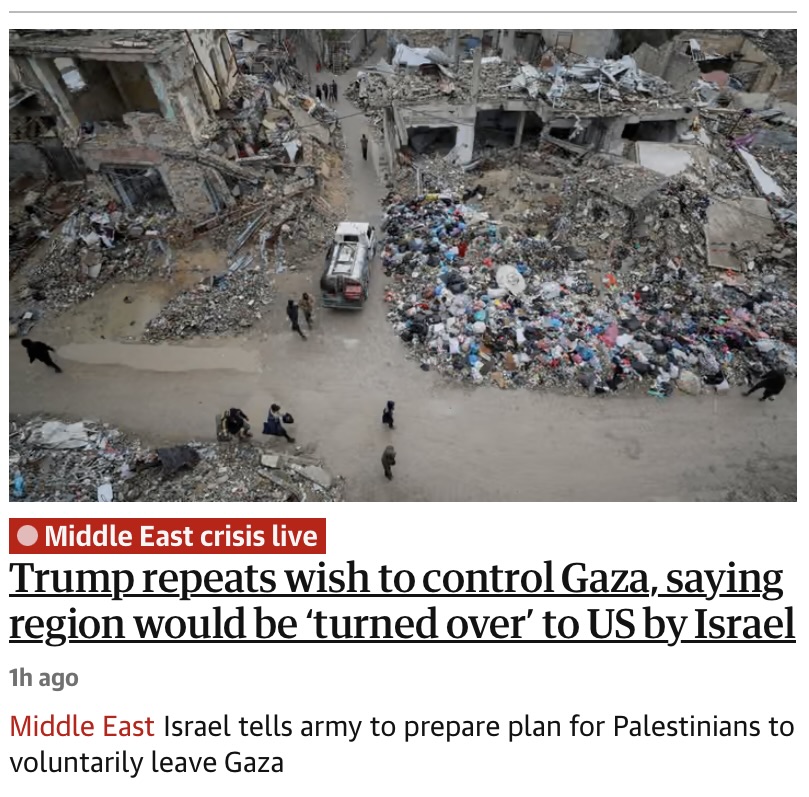
Earlier this week, the February issue of e-flux journal went online, including my essay “Improbable Potentialities.” Towards the end of the text, I briefly discuss Netanyahu’s plan for a Dubai-style redevelopment of Gaza, minus its inhabitants; this had been made public in the spring of 2024, complete with spectacular “artist’s impressions.” Pretty much simultaneously with the issue going live, Trump gave a press conference in which he announced that the US would take over Gaza, via its military, expel the Palestinian population, and develop the appropriated land into desirable “property.”
We live through a period in which every attempt to theorize the present, to articulate its contradictions and effect some sort of dialectical critique, will usually already be outdated when published—at least in some of its details. There comes a point when one has to stop updating and hope that some of the analysis and some of the propositions can still be relevant and make a difference, somehow, somewhat, circuitously.
The policing of what can be said and shown in Germany and Austria (we should not forget about Austria) is only becoming more stringent, as the hegemonic Mehrheitsgesellschaft imposes its one-sided social contract on critical voices. Many of those happen to be racialized, read as Muslim Others; in any case, it is often those critical voices who pay a real price for refusing to be complicit in a leaden culture of fearful, complicit silence that is accompanied by insistence that only institutions and think tanks run by white Germans can properly define key concepts (colonialism, apartheid, genocide), and by grotesque denials and distortions of facts. As veteran journalist Dominic Johnson acerbically noted, “Some Germans are spending a lot of energy asserting it isn’t cold enough in Gaza for babies to freeze to death, as was reported. The last time so many Germans tried to work out the right temperature to die of cold was during human experiments in Nazi concentration camps.”
Under these circumstances, exhibitions that cannot happen may be more significant than exhibition that do take place. On the one hand, you may have a major Frankfurt retrospective (which will travel to Vienna) by a veteran of institutional critique that focuses on an indeed impressive career. In an accompanying interview, the artist’s body of work is presented as a sequence of triumphs of criticality, without the kind of acknowledgement of the current context that would make the work truly resonate and turn it into a critical tool. The elephant in the room is studiously avoided, apart from one question tucked away in the “Frankfurt Poll” devised by the artist: “In the Middle East conflict, whom do you sympathize with?” The use of statistics and infographics in institutional critique is an interesting subject in its own right; here, the aesthetics of administration serves as a tool of neutralization (there is an abstract “conflict” between two sides, and one may sympathize with one, or both, or none) that allows for business as usual to continue. Catalogues and reviews are published at the cost of turning critique into its own simulation (along the lines pioneered by Texte zur Kunst), and some of the most vicious McCarthyite newspapers in Germany published grudgingly respectful reviews (see here and here). The social contract of white supremacism rebranded as “anti-Antisemitism” has been upheld. Praise be.
Meanwhile, in Vienna, an artist with far less access to the property that is whiteness cancels an exhibition at the Belvedere 21 because she was expected to show the kind of “joyful” work and “cute stuff” that got her invited, rather than addressing a certain geographical location or colonial regime, or enter into collaboration that “might imply solidarity with this or that human.”
I don’t know the details of the exhibition proposal and the ensuing negotiations, and indeed do not know Rabbya Naseer’s work beyond this video—a lecture-performance of her letter of refusal, available online in two versions. This is the kind of work that can still be produced and shown when infrastructures are compromised, precarity is intensified, and “cancel culture” morphs from a culture-wars trope into a dismal reality. There would be more to say this, about what is “not allowed” or “not possible,” and how this letter and this reading constitute meaningful historical practice in the contested present.
At the end of a year that has been gruelling in all too many different ways, I cannot pursue this line of inquiry right now. I would just say the following: Sometimes it’s better not to have a museum show. If you cannot discuss the elephant in the room, get out of the room. Look for different rooms; create Denkraum and Handlungsraum wherever possible. Silence = Death. Strike Austro-Germany.
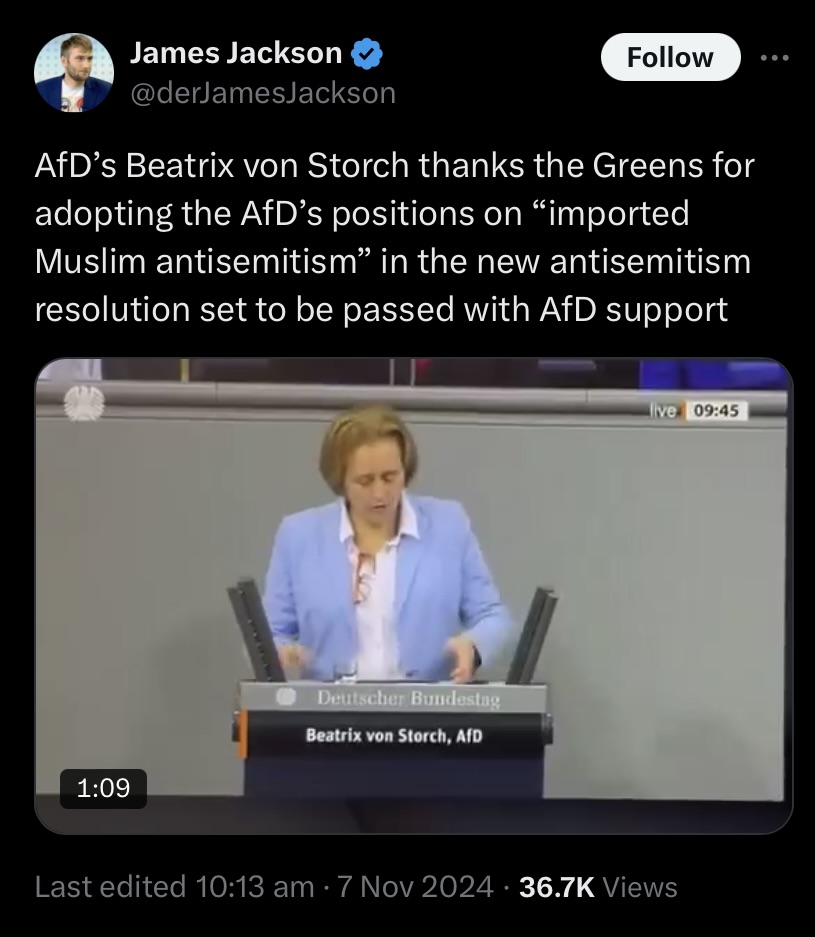
E-flux journal is publishing the English text of an email conversation on autonomy that the late great Marina Vishmidt and I had last winter. The timing of this issue is quite something: right after the American presidential election, and on the day that the German Bundestag has passed a resolution designed to stifle critical voices in academia, art and the media even more effectively. With the coalition government just having collapsed and the call for new elections getting louder, this is effectively a “lame duck” parliament, yet a depressingly impressive cross-party alliance has felt the need to intensify the repression of pro-Palestinian and anticolonial voices. It may look like like a genocide, walk like a genocide and quack like a genocide—but, for heaven’s sake, don’t say the g-word! With Netanyahu already rejoicing in Trump’s victory, the German parliament is effectively paving the way for a future right-wing coalition that will be in step with the US regime. And the latter, in turn, will no doubt take a page out of the German McCarthyite playbook.
I do hope that word is getting out about the situation in Germany. One way of honouring Marina would be to strengthen the Strike Germany movement as much as possible, and only agree to work with those (people within) German institutions that prove their divergence from the state of utter intellectual, political and ethical bankruptcy that marks the Tscherman governing caste. If you are invited by a German academic institute, art space or magazine, don’t say yes and be surprised later. If you don’t know the people in question already, or perhaps even if you think you do: Don’t assume shared values but press them, test them.
Issue no 189 of October contains my essay “Counterpublics in Search of Infrastructures: Lessons from German Anti-Antisemitism.” The situation in Tschermany keeps going from bad to worse. It may seem almost frivolous to focus on this situation, given what is going on in Gaza and in Lebanon, yet Germany’s silencing and slandering of critical voices (Palestinian and others; often poc, and often women) is of course directly related to Germany’s ongoing support for neocolonial necropolitics.
Images: pamphlets reprinting texts on Palestine, Israel and Lebanon (bottom image showing excerpts from June Jordan and Gilles Deleuze).
The latest issue of the Nordic Journal of Aesthetics(vol. 33, no. 67) was edited by Tobias Dias and Maja Bak Herrie, and is titled Aesthetics in the Age of Unreason. From the editorial:
We live in an age characterized by an expansion and deepening of the instrumental reason of capital, an increasing prevalence of reactionary and even fascist irrationalism and “post-truth” myth- making, and a fundamental proliferation of digital technologies of artificial intelligence and other vast information infrastructures mediating our social relations and climate.
Rather than the liberal Zeitdiagnose of a “post-truth era,” it seems more fitting to designate this conjunction an age of unreason, in line with the tradition of the Frankfurt School, as recently revisited by the late Bernard Stiegler and Achille Mbembe. Whereas Mbembe has argued that the colonial history of modernity, with its constitutive division of reason and unreason, the (white) liberal subject and the subjugated Black subject, outlines a “history of reason’s unreason” that to this day constitutes contemporary societies and their public spheres, Stiegler theorized the emergence of a de-formed reason and stupidity as a key tendency in today’s globalized, digital technoculture.
For both theorists, the dialectical tension between reason and unreason—the historical task of Aufklärung with its exclusion, racialization, and proletarianization—takes intensified and ever-more contradictory forms in the 21st century. Following Paul B. Preciado and many others, it seems fair to assert that we are living through an enormous “epistemological crisis” re-addressing the fundamental question of access to knowledge and our ability to know. It’s this overall crisis that marks the current “age of unreason.”
In my contribution, “Dialectic of Barbarism,” I respond to this prompt somewhat indirectly. Under the impact of the genocide in Gaza, I revisit the aesthetic and political figure of the barbarian (the Other of Civilization and Enlightenment) and some of its recent appropriations and transformations by racialized writers and activists.
Mere days after the conclusion of its incredible project with Marwa Arsanios,usufructuaries of earth,BAK in Utrecht was informed that the municipality is withdrawing its funding – which accounts for almost 50% of the budget. If this decision is not reversed, it will likely be the end for this vital infrastructure, at a moment when critical spaces in art and academia are increasingly rare and ever more precarious. BAK has released a statement in response to this callous death sentence, and gathered many solidarity statements. One of the most striking remarks comes from Nicoline van Harskamp: “After more than 2 decades, all ways of practice and thought lead back to BAK in some way.” At any given moment, there are at best a handful of institutions that actually matter, that produce projects that escape and counter the relentless glut of craven trendiness and clueless genericness that is the staple of art spaces and art magazines. BAK has been one of those few spaces in Europe. At this rate, with supposedly progressive city councils doing the far right’s work for them, there won’t be anything left.






 Sven Lütticken: Texts and Projects
You must be logged in to post a comment.