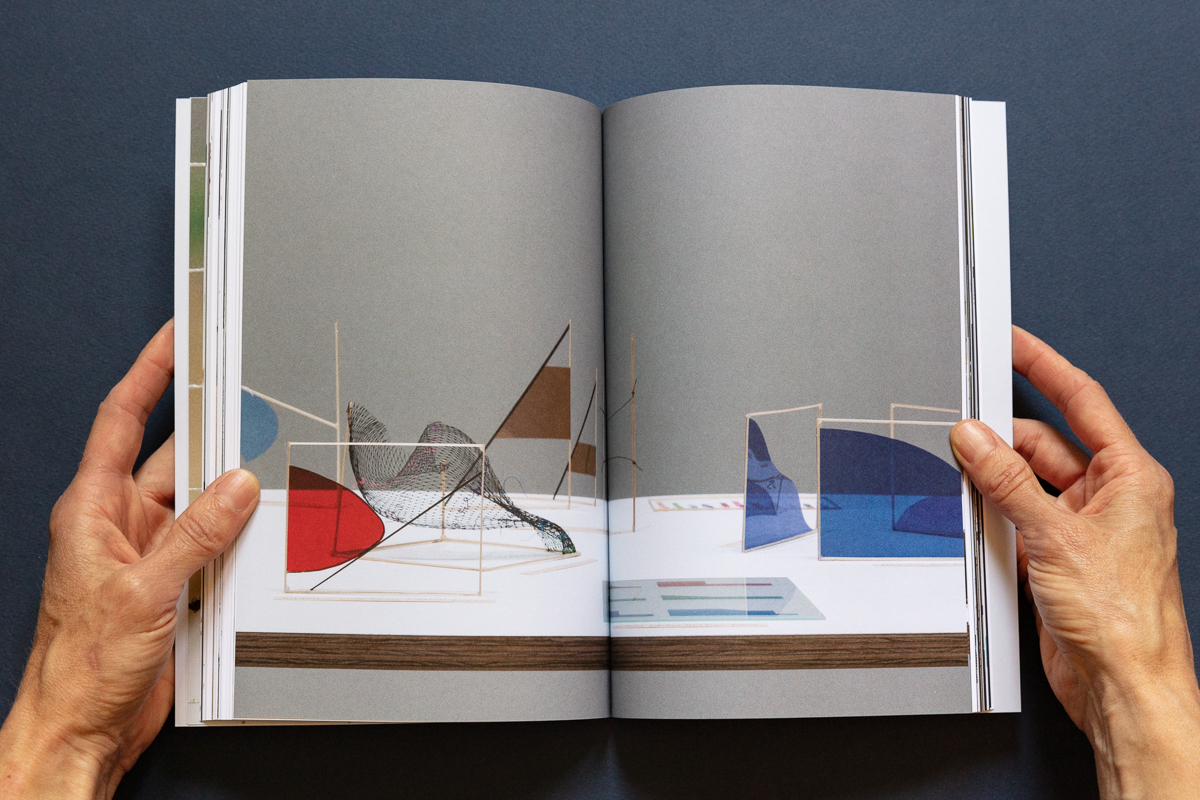
Out now from XYZBOOKS is a long-delayed yet still timely publication around Richard Ibghy and Marilou Lemmens’s series The Prophets:
This book focuses on Richard Ibghy & Marilou Lemmens’ seminal work The Prophets (2013–2015), a delicate hand-made collection of 412 small, whimsical sculptures made from everyday materials that renders economic graphs into makeshift models. In this work, the artists explore what it means to move from a material world of entangled, interacting agents to a world of mathematical modelling and graphical abstraction. The Prophets cuts across a wide range of historical and contemporary topics of interest to economists such as labour, consumption, production, taxes, savings, investments, credit and so on, to constitute a diagrammatology of economic thought. With essays by Sven Lütticken, Harro Maas, Marina Roy, and Jakub Zdebik and Foreword by Peggy Gale.

The various texts appear to form a great constellation with the documentation of the project. I have to look further into it, but my first impression is that this is how to do it; how to extend artistic practice and research in publishing, in dialogue with various scholars and theorists. If anything, my own contribution (“Prophetic Realism,” an offshoot of Objections) feels fairly minimal and minor, due to time and energy constraints—but I’m glad to be part of the mix.

 Sven Lütticken: Texts and Projects
You must be logged in to post a comment.